Dust collectors are important for keeping industrial environments safe, efficient, and compliant. They remove airborne dust and other particles generated during operations, protecting both people and equipment.
By pulling contaminated air through a system of ducts, and filters using a fan or blower, air is cleaned and either safely exhausted or returned to the facility. This reduces the risk of fires, explosions, contamination, and other safety risks.
Because dust collectors often operate continuously, bearing condition monitoring becomes a priority. Fan and motor bearings are exposed to dust ingress, imbalance, and lubrication challenges, and even minor degradation can escalate quickly into major failures if left undetected.
Effective maintenance of your dust collection system starts with consistent monitoring, record keeping, and preparation. When fans, motors, and bearings are inspected regularly, and their condition is recorded, common failure modes like dust ingress, imbalance, and lubrication degradation are caught early and corrected.
In the early morning, a critical dust collector failure brought operations to a standstill for approximately 6 hours of downtime and nearly $400,000 in lost revenue.
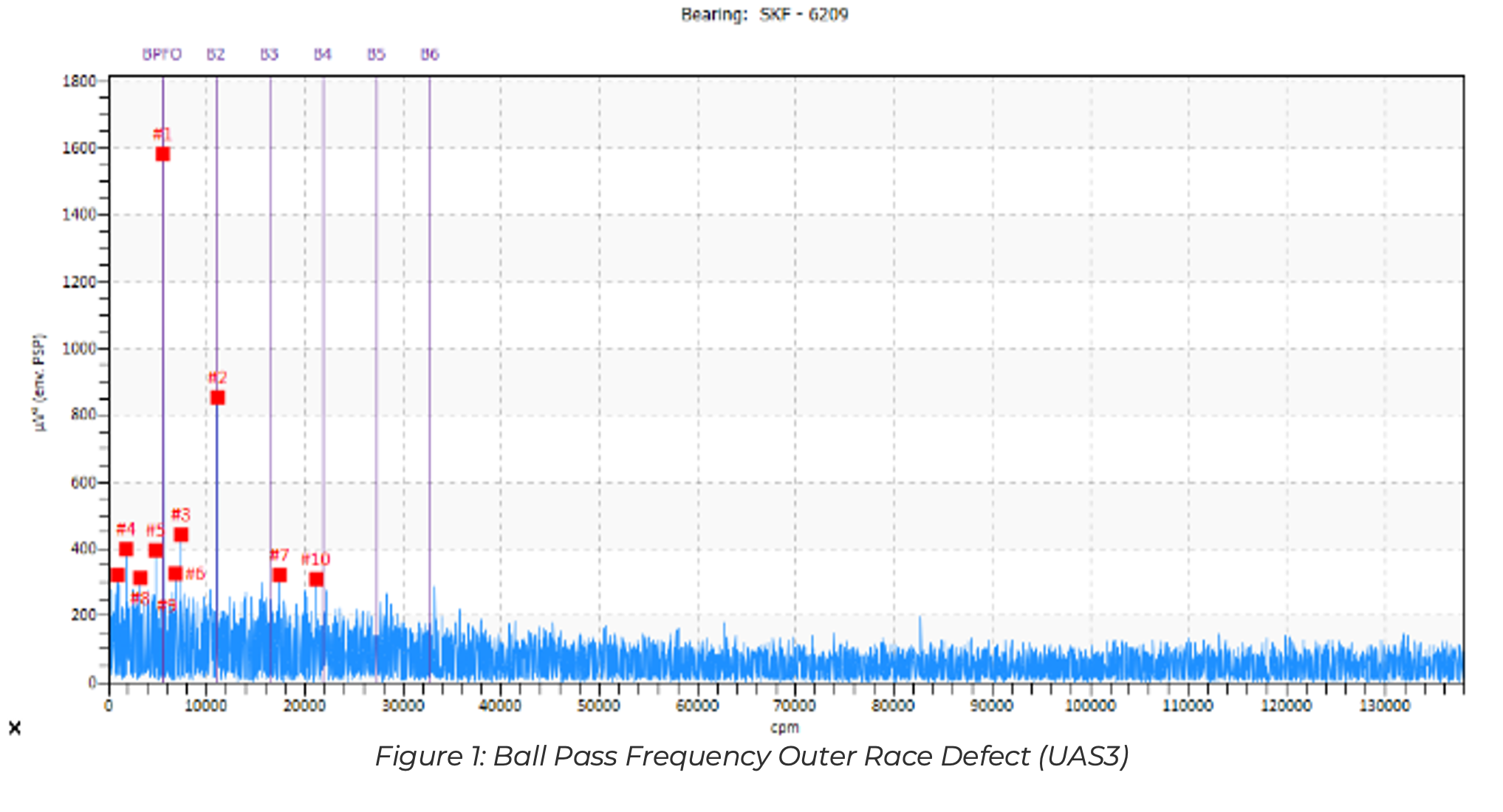
A bearing failure, previously noticed during an SDT340 inspection route led to shaft seizure. The resulting damage was total motor failure. To restore operations, a rush order was placed for a replacement motor that still needed to travel 150 kilometers to complete the repair.
Prior to the failure, bearing condition data was recorded and can be observed in Figure 1. Using the Bearing Toolbox Feature in SDT’s Analysis Software, UAS3. Fault frequency cursors matched to that specific SKF 6209, at that rotational speed indicate the bearing had a ball pass frequency outer race defect.