
Ultrasound Compressed Air Leak Detection
Find Compressed Air Leaks Fast & Easy with Ultrasound
Compressed air is among the most common industrial utilities, and one of the most wasted. Many industrial operations lose 30-40% of their compressed air supply to system leaks without noticing the impact.
During production, plant noise masks them, but when the plant is quiet, the hiss of wasted energy becomes difficult to ignore.
Regular compressed air leak surveys with SDT’s Ultrasound Leak Detectors help maintenance teams find, document, repair and verify leaks before they drain resources.

The Cost of Ignoring Compressed Air Leaks
Compressed air leaks waste more than electricity. They force compressors to run longer and wear out sooner, consume more energy. and reduce system pressure.
A 30% leak rate in your compressed air system means more energy cost, system wear and potentially unavailable pressure needed for production and processes.
75%
Of compressed air cost is energy, not infrastructure.
30-40%
of compressed air supply is lost to leaks.
25-30%
of leak energy drain is recovered after one survey.
5-15%
Realized energy expenditure reduction after one survey.
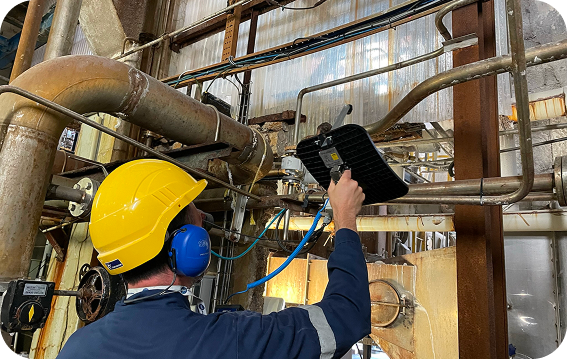
A Faster Way to Find and Quantify Compressed Air Leaks
Ultrasound is a simple to use compressed air leak detection tool. When compressed air escapes from a pressurized system it generates a lot of ultrasonic turbulence which can be isolated with sensors that listen above the range of human hearing.
Ultrasound leak detectors heterodyne high-frequency signals so technicians can hear them on the headphones of their ultrasound data collector and see them on their acoustic imaging camera.
High-frequency emission detection filters out the audible noises coming from the factory floor. Thanks to this, ultrasound technicians can reliably detect compressed air leaks even in loud industrial environments.
Unreliable Steam System Consequences
As compressed air leaks multiply across a facility, they increase energy demand, reduce available system pressure, and place unnecessary strain on the equipment responsible for supplying production.
Left unchecked, compressed air leaks lead to:

Energy waste and rising energy costs

Emissions rise, sustainability goals slip away

Equipment runs longer and wears out faster

Production risks with every unseen leak
Most Common Leak Spots
Compressed air leaks can occur anywhere along a distribution system, some of the Most Common Leak Spots occur at the fittings, hoses, regulators, and drain devices.
Internal diaphragms wear and crack over time, allowing compressed air to leak through the regulator.
Damaged O-rings and heavy use make quick couplers one of the most common compressed air leak points.
Rubber hoses are easily damaged by traffic, abrasion, and bending, leading to cracks and air leaks.
Faulty drain valves and fittings can leak compressed air while removing condensate from the system.
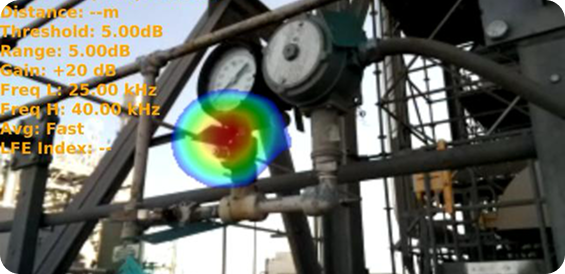
Air Leak Detection Services
SDT’s air leak detection services identify leak locations, estimate energy losses, and provide a clear, repair-ready report. Whether you need a single leak survey or ongoing program support, our professionals can help.
A Simple Compressed Air Leak Inspection Process
Learn how to use ultrasound find and document compressed air leaks. This full step-by-step guide walks you through preparing your equipment, inspecting the system, confirming leak locations, recording findings, and reporting leaks for repair.
01
Plan the Route
Map out your inspection path, gather the right ultrasound equipment, and ensure proper PPE is in place for safe, efficient scanning.
02
Perform the Scan
Use airborne sensors or acoustic imaging to sweep across target area. Listen and look for ultrasonic signatures of turbulence caused by compressed air or gas leaks.
03
Analyze and Report
Review collected data, tag leak locations, and quantify losses. Use tools like SonaVu Insights or LEAKReporter to prioritize repairs and track ROI.
04
Repair and Verify
Fix the identified leaks, then resurvey the same areas again to validate repairs and ensure no leaks were missed.
Our Leak Detection Tools
Ultrasound leak detectors find leaks easily and reliably. Modern ultrasound tools allow technicians to not only locate leaks, but also document and quantify them, turning a leak survey into a measurable energy savings project.
- Scan while systems are operating, no shutdown required
- Tag and quantify leaks with reporting tools like Leak Reporter or SonaVu Insights
- Estimate energy cost and prioritize repairs
- Build repeatable inspection routes for ongoing leak management
Simplify compressed air leak detection with the SDT340, a condition monitoring data collector that combines airborne & contact ultrasound with vibration to capture the full health of production assets.
Learn MoreSonaVu+ is an acoustic imaging camera designed to thrive in tough industrial environments. It visualizes ultrasound to find compressed air, gas and vacuum leaks, electrical faults, mechanical anomalies and more.
Learn MoreSonaVu InSights™ transforms every inspection into a professional and actionable report. Documenting then ranking leaks based on severity and impact, while energy losses are calculated to prove ROI.
Learn MoreThe LEAKChecker is a cost-effective, purpose-built ultrasound tool for detecting, documenting, and repairing compressed air, gas, and vacuum leaks. Reduce energy waste and improve asset efficiency with the LEAKChecker.
Learn More
Partnering with SDT Ultrasound Solutions
SDT Ultrasound Solutions has been supporting industry for more than 50 years, helping organizations around the world get more out of their production processes, condition monitoring equipment and reliability strategy.
Our purpose-built solutions, training, and services empower you to reduce unplanned downtime, optimize maintenance schedules, and protect your mission-critical equipment. When you partner with SDT Ultrasound, you gain more than a vendor. You gain a proactive partner prepared to support your reliability journey with the tools, training, and partnership needed for success.
Compressed Air Leak Frequently Asked Questions
Compressed air leak detection is the process of locating and documenting air escaping from a pressurized compressed air system. Using ultrasonic leak detection tools, technicians scan piping, fittings, hoses, regulators, and more, while the system is operating and under pressure to identify and quantify leaks.
Ultrasound enhances one of our core senses, hearing. Rather than relying on the human ear alone, ultrasonic leak detection equipment filters out unwanted plant noise and allows technicians to focus on the high-frequency turbulence created when compressed air escapes through a leak.
Through a process called heterodyning, ultrasonic signals are converted into audible sound, allowing technicians to hear, locate, and evaluate leaks that would otherwise go unnoticed. Some instruments, such as the SonaVu Acoustic Imaging Camera, can also visualize ultrasound, allowing technicians to see the exact location of leaks while scanning large areas from a distance.
Compressed air leaks are easy to ignore because they rarely create an immediate problem. Unlike water or oil leaks, they don’t leave a puddle on the floor, create a noticeable smell, or typically present an immediate safety hazard. Since they are often invisible and difficult to hear in a noisy plant, maintenance teams naturally prioritize equipment failures, production issues, and safety concerns instead.
Without dedicated tools, scheduled inspections, or an established leak management program, compressed air leaks can continue wasting energy for months or even years before they’re discovered.
Yes. In fact, compressed air leak detection can only be performed while the system is pressurized. Without pressure, there is no escaping air and therefore no ultrasonic turbulence to detect.
Ultrasound inspections are routinely performed while equipment remains in normal operation, allowing technicians to inspect compressed air systems without interrupting production. As with any maintenance activity, inspections should always be performed safely and in accordance with plant safety procedures.
Before an initial compressed air leak inspection, especially if it’s been a while since the Laos compressed air leak survey, it’s common for industrial facilities to be losing 30 to 40% of their compressed air leak supply to leaks.
Depending on the size of the system and local electricity costs, the savings from a compressed air leak survey can represent 10s of thousands or even hundreds of thousands of dollars in energy waste on an annual basis.
This impact does go beyond electricity costs. Excessive compressed air leaks force compressors to run longer, which increases equipment load, reduces available system pressure, and can affect production if pneumatic equipment lacks sufficient pressure.
Yes. Acoustic imaging cameras are specifically designed for applications such as compressed air leak detection.
Unlike a traditional ultrasound sensor, which detects sound within its field of view, acoustic imaging cameras use large arrays of digital MEMS microphones to precisely locate and visualize ultrasonic sound. This allows technicians to quickly scan large areas, inspect overhead piping, locate leaks from significant distances, and pinpoint the exact source of a leak with confidence.
Their speed, ease of use, and ability to visualize ultrasound make acoustic imaging cameras one of the fastest ways to perform plant-wide leak surveys.
Yes, but detection depends more on airflow than simply pressure or hole size.
Ultrasound detects the high-frequency turbulence created by escaping compressed air. Very small leaks under sufficient pressure typically produce turbulent flow that ultrasound detects extremely well. However, when airflow becomes extremely low and transitions toward laminar flow, very little ultrasonic energy is generated, making detection less reliable.
For the vast majority of industrial compressed air leaks, ultrasound provides fast, accurate detection.
Leaks are typically prioritized based on estimated energy loss, repair effort, accessibility, safety considerations, and operational impact. SDT Ultrasound Solutions offer several tools like the LEAKReporter App and SonaVu InSights That help leak detection teams communicate and prioritize leak repairs.
Yes. Ultrasound detects the turbulence created when pressurized gas escapes through a leak, not the gas itself.
In addition to compressed air, ultrasound can detect leaks in nitrogen, oxygen, argon, carbon dioxide, steam, vacuum systems, and many other industrial gases, provided sufficient turbulent flow is generated.
Compressed air leaks most commonly occur at quick couplers, threaded fittings, push-to-connect fittings, flexible hoses, pressure regulators, FRLs, automatic drain traps, point-of-use connections, and compressor outlet valves.
These components experience constant vibration, pressure cycling, movement, and wear, making them the most common sources of compressed air leakage.
That depends almost entirely on how quickly identified leaks are repaired. However, it is common to identify enough wasted compressed air during only a few hours of surveying to justify the cost of the inspection, or even the purchase of an ultrasonic leak detector.
Once the highest-priority leaks are repaired, many facilities begin realizing measurable energy savings almost immediately.
Absolutely. Compressed air leak detection has one of the lowest barriers to entry of any predictive maintenance technology while often delivering one of the fastest returns on investment.
With the right ultrasound equipment and proper training, most facilities can successfully perform leak surveys in-house. For many plants, a single technician inspecting the compressed air system once or twice each year is enough to maintain an effective leak management program.
Organizations starting a new program often benefit from consulting with an experienced reliability specialist to determine inspection frequency, reporting methods, and the overall inspection strategy.
Yes. Compressed air systems are constantly changing as fittings loosen, hoses age, components wear, and maintenance activities introduce new opportunities for leakage.
One of the most important times to perform a leak survey is immediately after equipment has been installed, repaired, or modified, since this is often when new leaks are introduced. Routine inspections ensure previous repairs remain effective while identifying new leaks before they become costly.
Inspection frequency depends on how critical compressed air is to your operation, how dependent production is on consistent system pressure, and the cost of wasted energy.
For many facilities, inspecting every six months provides an excellent balance between inspection effort and energy savings. Annual surveys are still beneficial, but waiting longer than a year often allows unnecessary leakage and operating costs to accumulate.
Yes. Ultrasound operates above the range of normal human hearing, allowing technicians to focus on high-frequency sound that is unaffected by most audible plant noise.
Through heterodyning, ultrasonic signals are converted into sounds technicians can easily recognize, making it possible to locate compressed air leaks even while nearby machinery is operating.
Finding a leak is only part of the process. Verifying repairs confirms the leak has actually been eliminated and that the expected energy savings have been achieved.
A quick follow-up inspection with ultrasound also identifies incomplete repairs or new leaks that may have been introduced during maintenance, helping maintenance teams close the loop on their leak management program.
Yes. As leakage increases, compressors must work harder to maintain system pressure. If compressor capacity can no longer keep up with demand, pressure begins to fall, reducing the performance of pneumatic tools, cylinders, actuators, and production equipment.
Many facilities respond by increasing compressor pressure or adding compressor capacity when repairing leaks would solve the underlying problem.