The following case study looks at the damaging effects of an electrical current finding a path to ground through a bearing, due to a loose rotor bar.
The issue was identified during an initial condition monitoring inspection performed by SDT at a new customer site. The data collection and analysis was performed by Trevor Bruinix and Gilles Lanthier, from SDT’s Partnered Ultrasound Services Team.
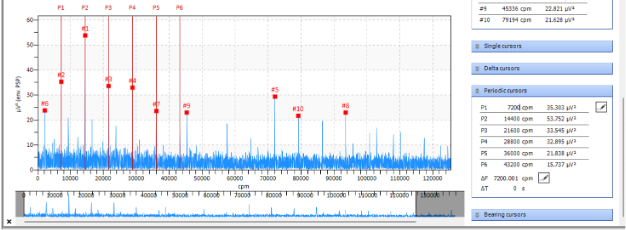
When a rotor bar becomes loose, electromagnetic forces cause it to lift and drop as it passes each stator winding slot. This repeated movement produces characteristic electrical and mechanical signatures. The rotor bar pass frequency (RBPF) can be calculated by multiplying the number of rotor bars by the RPM of the asset.
Rotor bar-related defects are commonly associated with elevated amplitudes at rotor bar pass frequency (RBPF) with harmonics. In advanced stages, these defects are frequently accompanied by strong electrical signatures at multiples of line frequency due to arcing and intermittent current discharge.