Cement production is rotating equipment heavy. To keep material moving through each stage of production, rotating assets must be monitored and maintained. Cement manufacturing involves a high concentration of slow-rotating equipment which can pose challenges for under-equipped maintenance and reliability teams.
Slow-rotating equipment often found within cement plants include bucket elevators, calendar rollers, rotary feeders, kiln trunnions, roller presses and more.
Vibration analysis is a widely used monitoring technology across rotating equipment and is extremely effective as an inspection and permanent monitoring tool. But at low rotational speeds, bearing fault energy is significantly reduced, limiting the effectiveness of vibration analysis for slow-speed asset monitoring.
The maintenance and reliability team at this cement factory used vibration analysis equipment for all rotating equipment and electric motors. But when it came to diagnosing bearing faults on their slow-rotating assets, defects often went unnoticed until they reached a severe stage. Until recently, when they added an SDT340 ultrasound data collector for their slow-speed bearing analysis.
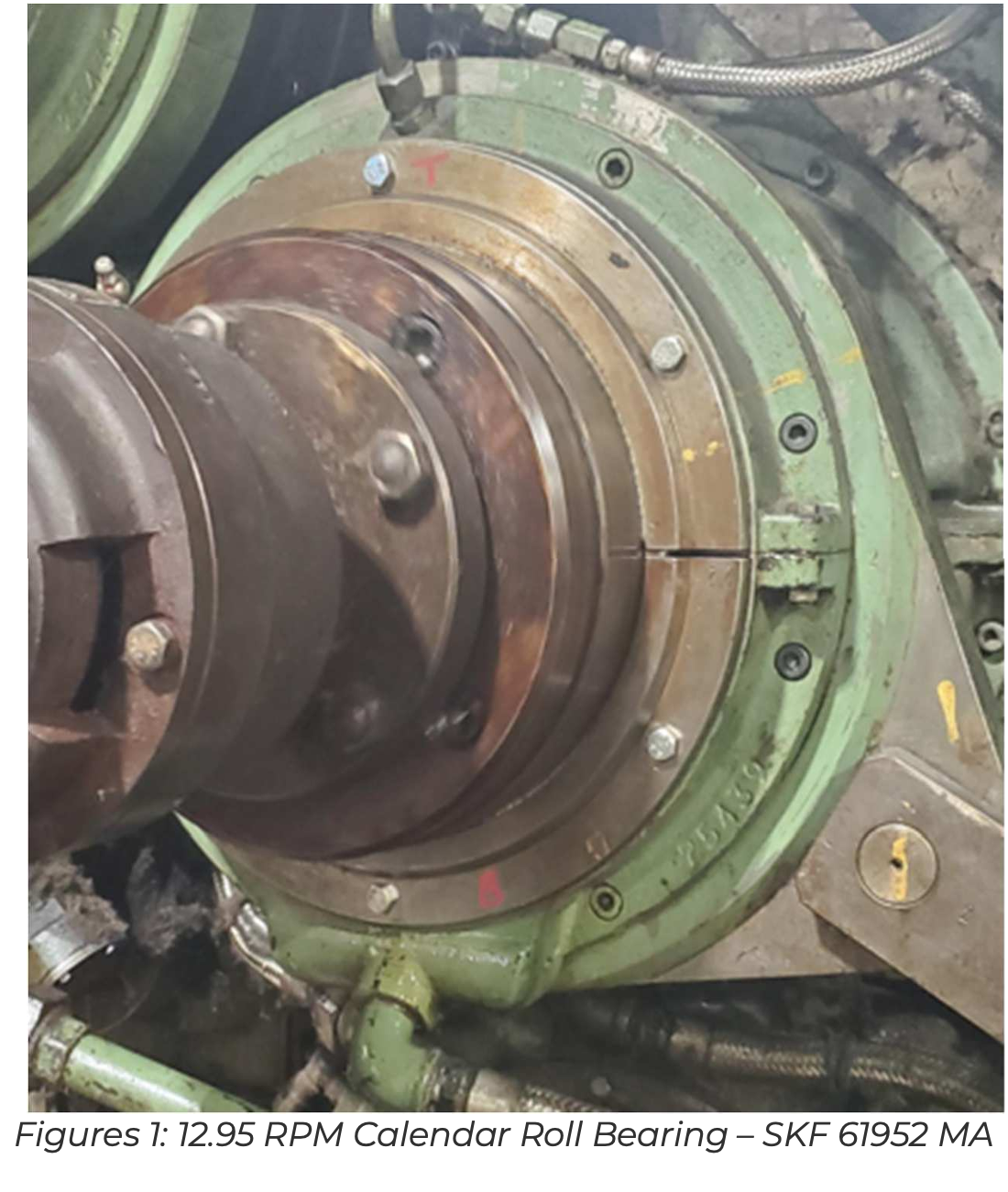
Figure 1 shows a slow-speed calendar roll bearing – SKF 61952 MA.
Ultrasound is the ideal predictive maintenance technology for diagnosing slow-speed bearing defects. It excels at detecting micro-sonic changes in the friction, impacting, and turbulence emitted from a bearing, which are always present, regardless of rotational speed.
Since implementing the SDT340 and UAS3 software, the maintenance team gained significantly better visibility into the condition of their slow-speed assets. During a routine inspection, abnormal ultrasound activity was detected on a calendar roller bearing rotating at just 12.95 RPM.
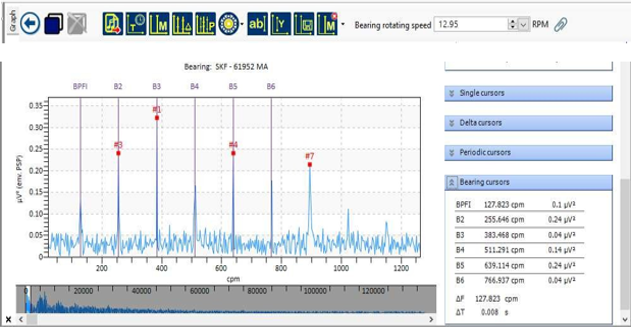
Using the Bearing Toolbox in UAS3, the team entered the bearing make and model (SKF 61952 MA) along with the operating speed. The software automatically calculated the expected bearing fault frequencies and aligned the frequency cursors accordingly. Analysis of the FFT revealed impact peaks reaching approximately 0.35 microvolts at the Ball Pass Frequency Inner Race (BPFI), indicating severe impacting consistent with an advanced inner race defect (Figure 2).
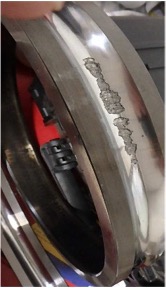
The bearing was monitored until the next planned shutdown, at which point it was replaced and visually inspected. As shown in Figure 3, the inner race exhibited significant physical damage, confirming the severity of the impacting identified in the ultrasound data. This direct correlation between ultrasound analysis and visual inspection validated the BPFI diagnosis made using the Bearing Toolbox and reinforced the effectiveness of ultrasound condition monitoring for slow-speed bearing applications.