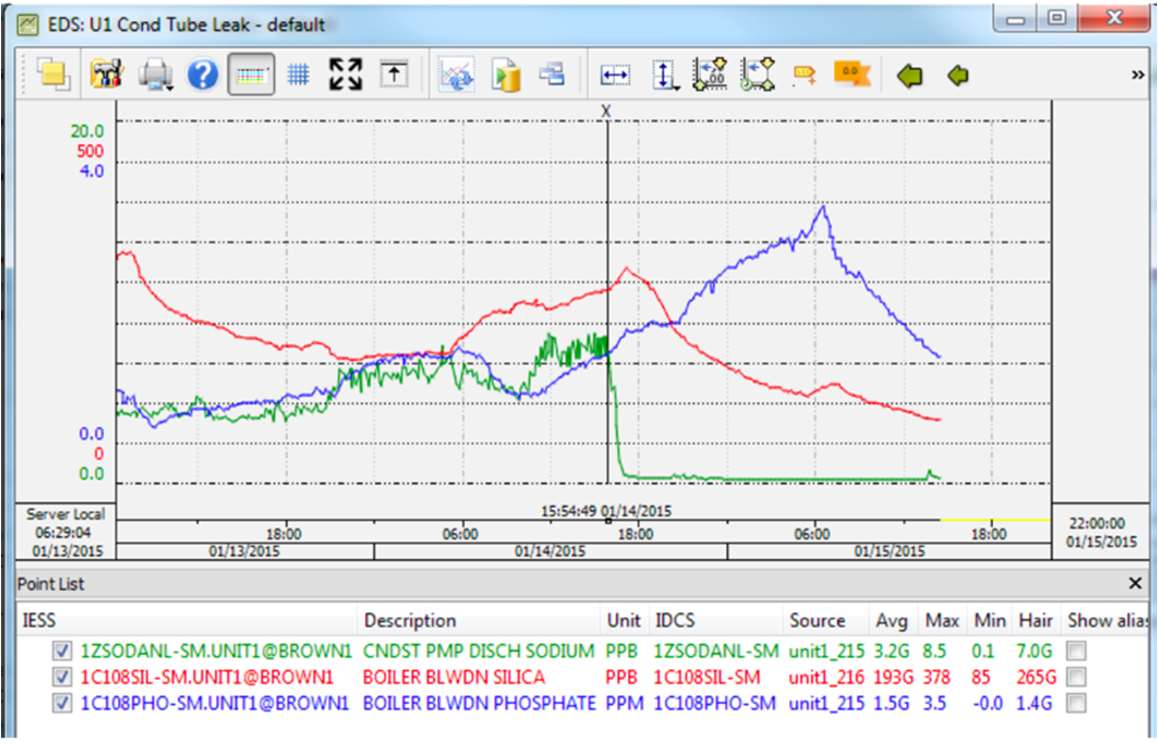
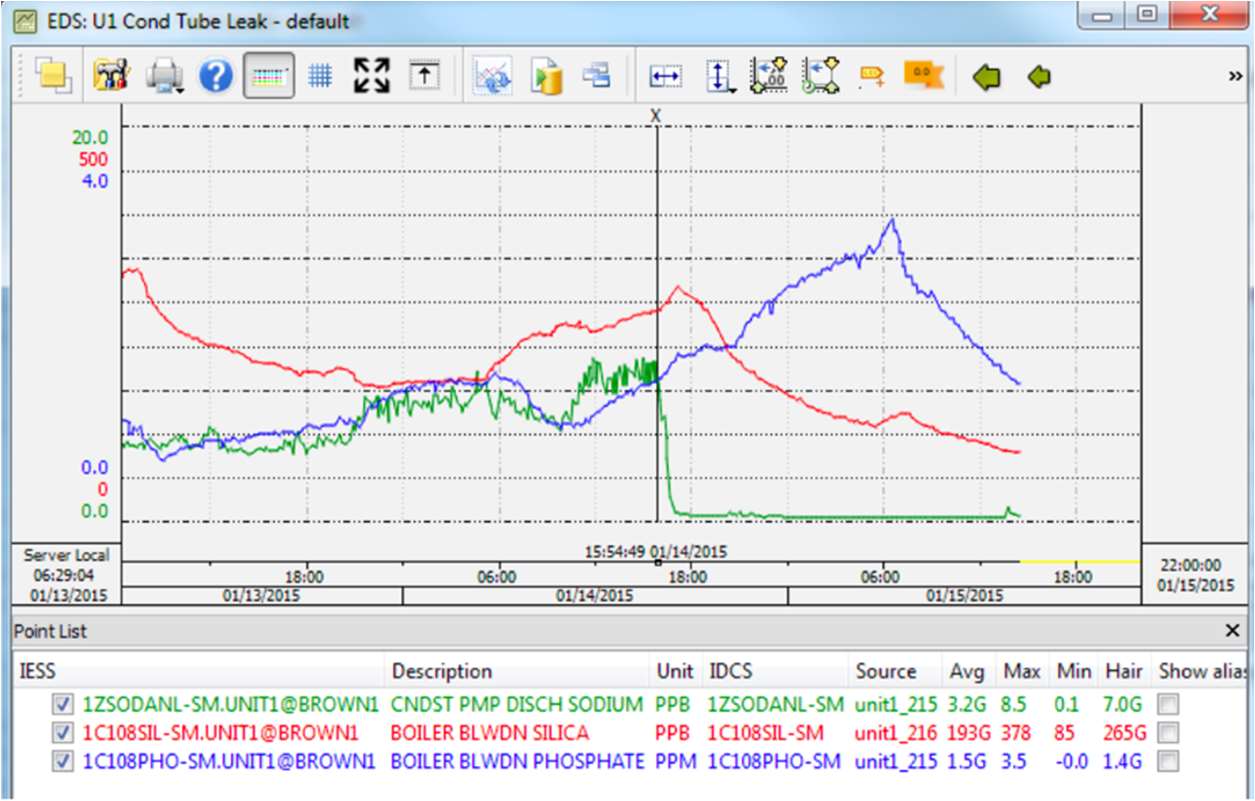
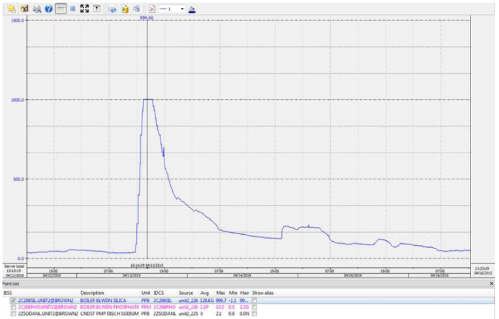
They knew they had a tube leak in Unit 2’s condenser. During a planned outage they did a dye hydro on it to locate the tube leak. This graph of Unit 2 shows the difference in the silica and the sodium when a tube leak is present. Disregard the area between 1/9 and 1/12 as this was the area that the Unit was offline and the condenser tube side was filled with water and dye. Just look at the difference in the “pink” (Silica) amplitude before and after.
A significant tube leak on Unit 2 caused reduction in output. The Unit was shut down on 1/10 and 1/11 for a dye test. Leaks were found and isolated. Silica levels restored to normal by 1/13 and 1/14.
Phipps and his team are experienced at battling condenser tube leaks.
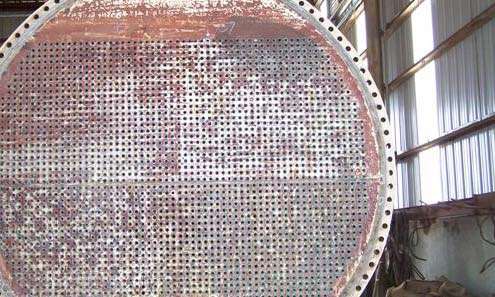
“We usually helium leak test for Condenser Tube Leaks.” Says Phipps. “The water side (inside) of the tubes are drained – the outside of the tubes (Shell) is under vacuum. The helium detector inlet is inserted into the vacuum pump exhaust. Helium is sprayed around on the water side of the tubes. We have a box fabricated that allows us to narrow the area of a condenser tube leak down so that we shoot areas of the tube sheet instead of shooting each individual tube. Once the general area is located, then individual tubes have helium shot in them.
“We had helium leak checked this half of the condenser 3 times, but determined that the leak was so small we could not find it. It requires half of the condenser to be taken out of service to leak check. This has a negative effect on heat rate, as well as during the summer months – Generator Output due to the backpressure created on the low pressure turbine.”
“We have the equipment and trained personnel to perform the Helium leak check. Since none of us had ever “heard” a condenser tube leak using the Ultrasound equipment, and when the leak increased to a point that we thought we could locate it, the half of the condenser was again isolated.”
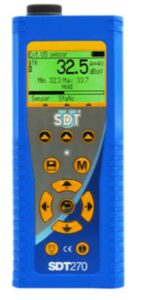
“A helium leak check was then performed and the two leaking tubes identified using Helium. I had instructed the Results Engineer and Maintenance crew that if they could find the tube leak using helium, I then wanted them to use the SDT270 unit to “listen” to what a tube leak sounded like. When performing a Helium Leak Check the time involved is at least a day per condenser half. We hoped to reduce that time using the ultrasound.”
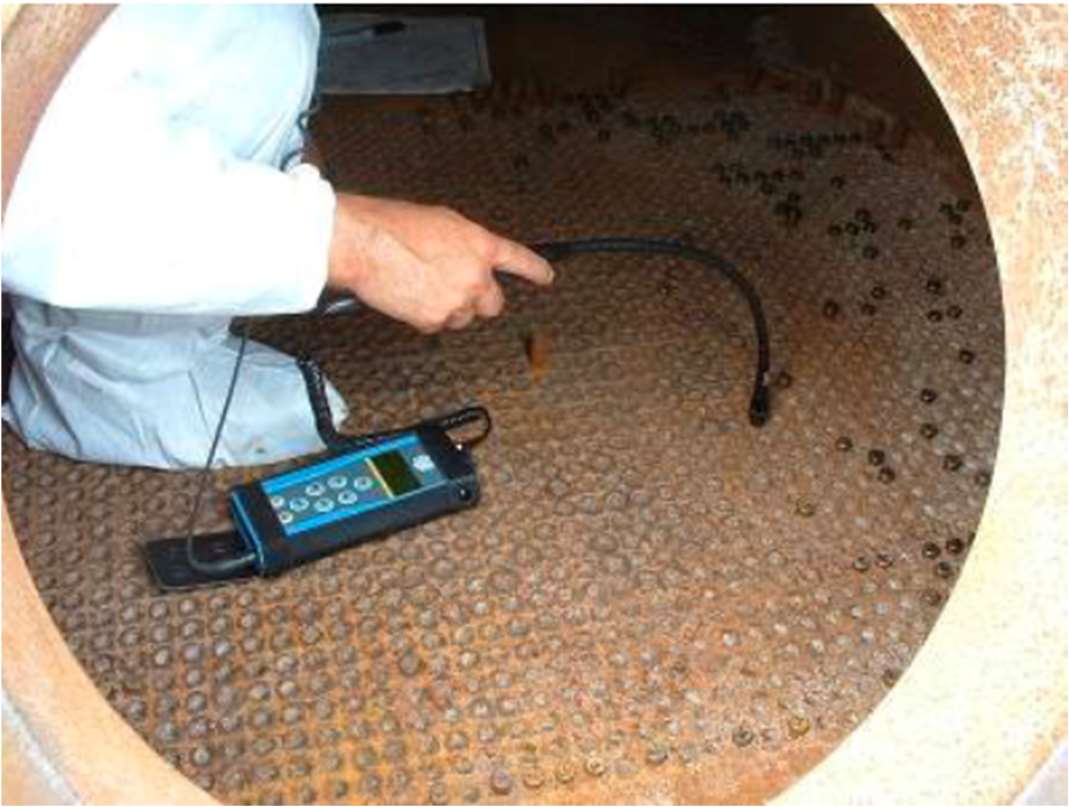
“Once the two tubes were identified – the Results Engineer took the SDT270 Unit into the Condenser. He started in an area that the helium had not identified a leak. He did not use the precision tip but just “scanned” the area. He said he heard nothing in the areas where the helium had not detected a leak. However when he waived the SDT270’s airborne sensor in the area where the tube leaks were known to exist, he started hearing noise. As he continued scanning over the tubes that were leaking he could hear a “psssst” then nothing as he moved away from the tube. He then put the precision tip on and started checking each individual tube in about a 5 tube by 5 tube area. He said when he checked the leaking tubes – he actually had to turn the sensitivity down on the SDT Unit.”
“In all – he scanned approximately 18,000 tubes in 30 minutes with the SDT270 compared to a whole day with Helium Tracer Gas. The SDT270 Unit narrowed the leak(s) down to a small area.”
“It is the Results Engineer’s opinion that we should use the SDT Unit for finding Condenser Tube leaks in that
1. “It is the Results Engineer’s opinion that we should use the SDT Unit for finding Condenser
Tube leaks in that He believes smaller leaks can be identified with the SDT270 Unit where they
cannot be detected with helium
2. He knows that he can find the leaks faster with the SDT270 Unit using the scanning method first.
3. It will be cheaper in that Helium Gas will not have to be purchased
4. It will also return the Unit to full load capacity faster by reducing
significantly the time that it takes to find leaks.”