

Delivering Evidence-Based Lubrication to Fin Fan Drive Motors
During a client visit to Saudi Aramco's Western Region Terminal Distribution (WRTD) facility in Yanbu, Saudi Arabia, I had the opportunity to investigate a question that challenges one of maintenance's oldest assumptions: can adding fresh grease actually make a healthy bearing worse?
The refinery receives crude oil that has travelled hundreds, even thousands of kilometres through pipelines across Saudi Arabia. Along its journey, both ambient desert temperatures and friction within the pipeline raise the temperature of the crude. Before entering the refining process, that heat must be removed. One of the critical pieces of equipment responsible for this task are banks of overhead fin fan coolers. Their continuous operation is essential to maintaining process efficiency and refinery throughput.
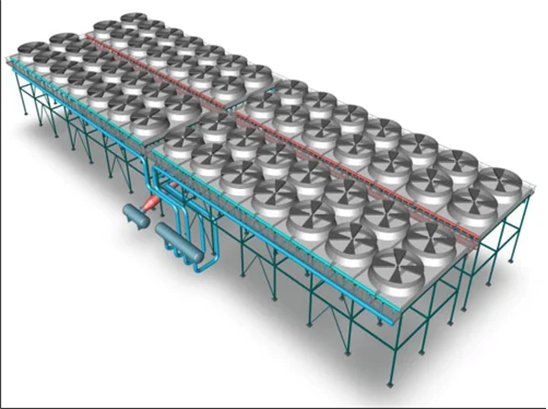
The vertically mounted electric motors driving the overhead fin fan coolers may appear unremarkable, but they perform a process-critical function. Every bearing must operate reliably because each motor contributes to removing the enormous amount of heat accumulated by the crude during its long journey through the pipeline network.
The focus of my visit was to demonstrate the sensitivity of the SDT340 ultrasound instrument during lubrication activities and determine whether it could identify even subtle signs of over-lubrication in the motor bearings.
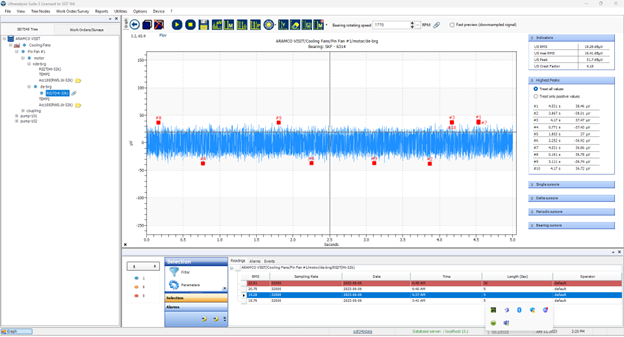
The motor utilized an SKF 6314 bearing operating at 1,770 RPM. Before any grease was introduced, a five-second ultrasound acquisition was performed with the bearing type and operating speed entered into the instrument. Those details are important because rotating speed directly influences the expected ultrasonic behaviour, while an adequate acquisition period provides sufficient data for meaningful statistical and waveform analysis.
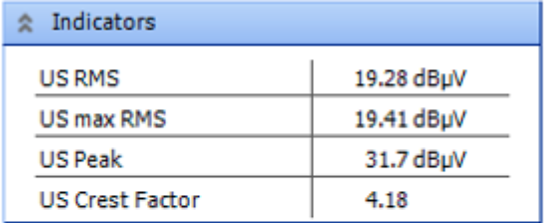
The initial inspection painted the picture of a healthy bearing. Static measurements showed remarkably stable RMS and maxRMS values (19.28 and 19.41 dBµV respectively), a modest Peak value of 31.7 dBµV, and an excellent Crest Factor of 4.18. Collectively, these indicators suggested stable friction conditions with no evidence of impacting or surface distress.
The dynamic waveform confirmed the same conclusion. The ten highest amplitude events were evenly distributed throughout the acquisition period, producing a waveform characteristic of normal friction rather than mechanical impacts. Based on both the static and dynamic evidence, I concluded that the bearing was operating normally and required no lubrication intervention.
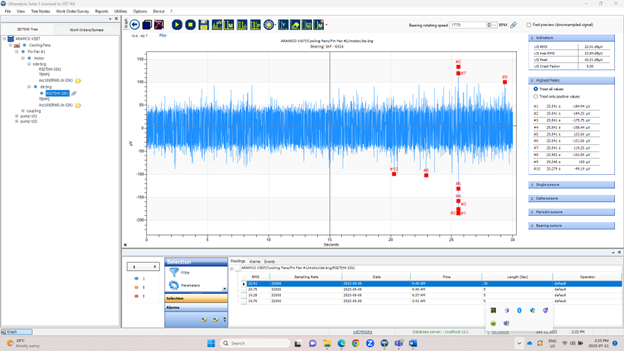
Nevertheless, at the asset owner’s request, eight shots of fresh grease were deliberately added to demonstrate the effect.
The results were immediate and unmistakable. While the bearing was certainly not damaged, its ultrasonic signature changed significantly. The highest amplitude events became clustered toward the end of the waveform rather than remaining evenly distributed. Crest Factor increased dramatically from 4.18 to approximately 9.5, indicating a growing population of transient impacts. Importantly, these impacts were non-sinusoidal and inconsistent with the signature of a developing bearing defect. Instead, they were characteristic of excess grease disrupting the formation of a stable lubricant film between the rolling elements and raceways.
So, can adding fresh grease actually make a healthy bearing worse? Absolutely!
The Aramco demonstration showed that a bearing exhibiting all the characteristics of healthy operation developed measurable signs of distress immediately after grease was introduced. Why? Because adding grease to a sufficiently lubricated bearing almost always builds pressure and forces thickener to churn in the raceway. The excess grease disrupted the lubricant film, increased transient impacts, and degraded the bearing's ultrasonic signature.
That is the fundamental principle of evidence-based lubrication. Grease should never be added because the calendar says it's time or because "one more shot can't hurt." Lubrication is a maintenance intervention, and like any intervention, it should begin with evidence that action is required and end with evidence that the action improved the machine's condition.
A world-class ultrasound lubrication program therefore delivers far more than an audible grease aid. It provides objective STATIC measurements that quantify bearing condition before and after intervention, DYNAMIC waveform analysis that explains why those measurements changed, and documented traceability for every lubrication event. It answers the questions every reliability program should be asking: Did the bearing need grease? How much was added? Did the bearing improve? And when should it be inspected again?
At Aramco WRTD, the SDT340 successfully demonstrated that ultrasound can detect subtle lubrication changes that traditional methods simply cannot. More importantly, it reinforced the philosophy that defines modern lubrication excellence: don't lubricate because you can. Lubricate because the evidence tells you to and verify that the evidence confirms you made the bearing better.