
Ultrasound Inspection for Mobile Equipment: 4 Practical Applications
Most condition monitoring routes stop at the plant floor. The equipment outside the plant does not.
Loaders, haul trucks, tractors, service vehicles, and other mobile assets work through dust, weather, vibration, changing loads, and constant movement. When something starts to go wrong, the first sign is often indirect: silica rises in an oil sample, a cylinder begins to drift, an air system will not hold pressure, or dust starts finding its way into a cab.
Ultrasound gives maintenance teams a practical way to move from that symptom to the source. By detecting high-frequency energy created by turbulent flow, internal fluid bypass, and loss of tightness, technicians can investigate problems that are difficult to see and often slow to localize with visual inspection alone.
With the SDT340 and the right airborne, contact, or tightness-testing method, the same ultrasound principles used across fixed plant assets can be applied to the fleet.
Why Ultrasound Fits Mobile Equipment Inspections
Mobile-equipment troubleshooting rarely depends on one technology. Oil analysis, pressure checks, visual inspection, fluid analysis, and OEM service procedures all answer important questions. Ultrasound adds something different: it helps narrow the search.
That matters when an asset is large, access is limited, and every hour in the repair bay affects production. Instead of dismantling components just to find out where the problem might be, technicians can use ultrasound to identify a stronger suspect and decide where closer testing is justified.
• Airborne ultrasound can localize positive- and negative-pressure leaks by detecting turbulence at the leak path.
• Contact ultrasound can reveal structure-borne activity associated with internal fluid bypass.
• An ultrasonic transmitter can create a test signal for cab, enclosure, and intake-system tightness checks when no natural pressure differential is available.
• Repeatable before-and-after measurements can help verify that a repair addressed the source, not just the symptom.
1. Diesel Engine Air-Intake Leak Inspection
A diesel engine can look perfectly normal and still be pulling unfiltered air downstream of the filter. On equipment operating around dust, dirt, and silica, a loose clamp, cracked hose, damaged pipe, corrosion point, or pinhole can create an intake path that allows contamination toward the turbocharger and engine.
Oil analysis is extremely useful here because it can show that contamination and wear are increasing. What it cannot do is point to the exact place where the intake system is losing tightness. That is where ultrasound becomes a useful companion to the oil data.
With the engine running, air being pulled through a small leak creates turbulence. A technician can scan the intake path with airborne ultrasound, moving from the breather and filter housing toward the turbocharger while listening for a focused leak signal.
If engine noise makes that approach difficult, the intake can also be checked with the engine off. An ultrasonic transmitter is placed inside the sealed volume and the exterior is scanned for signal escape. The stronger the transmitted signal at a joint, clamp, hose, or pipe section, the stronger the reason to inspect that point more closely.
The practical advantage is speed. Oil analysis tells the team there is a contamination problem. Ultrasound helps the mechanic find where to look next and provides a straightforward way to recheck the repair before the asset returns to service.
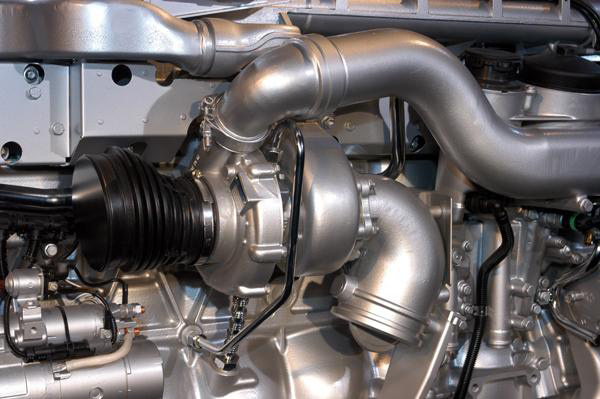
Typical air-breather and turbocharger system on heavy equipment.
2. Hydraulic Cylinder Internal Bypass
A hydraulic cylinder does not need to leak oil externally to have a sealing problem. If pressurized fluid bypasses the piston seal internally, the cylinder can lose force while the fluid remains inside the barrel.
The symptoms can look familiar: slower movement, reduced lifting force, drift, trouble holding position, or a cylinder that stalls sooner than expected. The challenge is that those same symptoms can also come from valves, pumps, pressure settings, restrictions, or contamination elsewhere in the circuit.
Contact ultrasound gives the technician another piece of evidence. By measuring structure-borne ultrasonic activity at repeatable points on the cylinder barrel under controlled conditions, the inspection can reveal concentrated activity consistent with internal fluid bypass and help decide whether the cylinder deserves deeper testing.
The goal is not to diagnose a hydraulic system from one sound or one number. It is to reduce the number of possibilities and move toward confirmation with better information.
3. Air Brake and Air Suspension Leak Detection
A pressure-loss test can confirm that a vehicle air system is leaking. Finding the exact fitting, valve, line, brake component, or air spring responsible is the time-consuming part.
Airborne ultrasound helps close that gap. Escaping compressed air creates turbulent flow, and that turbulence produces a directional ultrasonic signal. A technician can scan the charged system and follow the signal toward the source, even when lower-frequency shop noise makes an audible hiss difficult to isolate.
This is especially useful on systems with many connections packed into a small area. Rather than treating every fitting as equally suspicious, the technician can focus on the points producing the strongest leak signature, make the repair, and repeat the scan.
Air brake systems are safety-critical. Ultrasound should support required pressure-loss tests, manufacturer procedures, and regulatory inspections. It is a localization tool, not a replacement for those checks.
4. Cab and Enclosure Tightness
Dust in the cab is more than an annoyance on a loader, tractor, or other heavy mobile asset. Poor door, window, vent, and panel seals can affect operator comfort, visibility, cleanliness, and the ability of the cab to keep the outside environment outside.
Tightness testing with ultrasound is straightforward. Place an ultrasonic transmitter inside the closed cab, then scan around the exterior seals and joints. Where more of the transmitted signal escapes, the inspection identifies a likely path for dust, water, or air ingress.
Because the method does not depend on wind or rain being present during the inspection, technicians can troubleshoot the seal under controlled conditions and verify the repair immediately afterward.

Ultrasound inspection of a tractor cab for seal tightness.
Build Mobile Assets into the Condition Monitoring Strategy
The value of ultrasound on mobile equipment is not that it replaces the tools already in the maintenance program. It makes those tools more useful by helping technicians move from an abnormal condition to a specific place to investigate.
An oil sample shows rising silica. Ultrasound helps locate the intake leak. A cylinder loses force. Contact ultrasound helps determine whether internal bypass is a credible suspect. An air system loses pressure. Airborne ultrasound helps pinpoint the source. A cab is taking on dust or water. Tightness testing helps identify the failed seal path.
The value of ultrasound on mobile equipment is not that it replaces the tools already in the maintenance program. It makes those tools more useful by helping technicians move from an abnormal condition to a specific place to investigate.
An oil sample shows rising silica. Ultrasound helps locate the intake leak. A cylinder loses force. Contact ultrasound helps determine whether internal bypass is a credible suspect. An air system loses pressure. Airborne ultrasound helps pinpoint the source. A cab is taking on dust or water. Tightness testing helps identify the failed seal path.
For teams responsible for both plant assets and fleet equipment, that versatility is valuable. The same SDT340 platform can support targeted troubleshooting across multiple failure modes, as long as the inspection method is matched to the problem the technician is trying to solve.